Some rivers can be understood from the shore; others reveal themselves only when navigated slowly, at the rhythm of the water. The Paraná belongs to the latter. Stepping onto a traditional barge means changing perspective and accepting an invitation to a quiet journey, where the landscape unfolds without artifice. From the river, the riverside jungle, hidden banks, and traces of the past take on a deeper meaning. Guided by local boatmen who have known these waters all their lives, the experience becomes an intimate passage where nature, history, and memory flow together.
Some journeys do not begin with distance, but with perspective. I had seen the Paraná River many times from the shore, yet it was only when I stepped onto a traditional wooden barge that I understood how little I truly knew it. From the water, the river speaks differently. It slows time, softens sound, and reveals a landscape that feels both ancient and quietly alive.
That first journey was guided by Omar, a local fisherman and baqueano whose life has been shaped by the Paraná long before the river was transformed with the construction of the Yacyretá dam, some forty kilometers downstream. For him, the river is not a destination or a resource—it is a living archive. Every current, every submerged tree, every bend holds a memory.
Here, the Paraná is a vast expanse of water, from fifteen to thirty thkilometers wide. The dam transformed this stretch into a great inland sea, submerging large portions of the riverside forest. Beneath the surface lie trunks, roots, and traces of a former landscape, invisible yet ever-present. Navigating these waters requires patience and deep knowledge—qualities Omar embodies effortlessly.
As the barge glided forward, he steered with the quiet confidence of someone who has learned to read the river as one reads the weather or the passing of seasons. He pointed toward the shore and spoke softly: where a path once crossed the forest, where a house once stood, where life had adapted and endured. The Paraná, for him, is a companion that changed form but never lost its spirit.
From the deck, the scenery unfolded slowly. Green banks hidden from land, fleeting beaches, silent islands, and dense riverside jungle created a sense of discovery that felt intimate rather than dramatic.
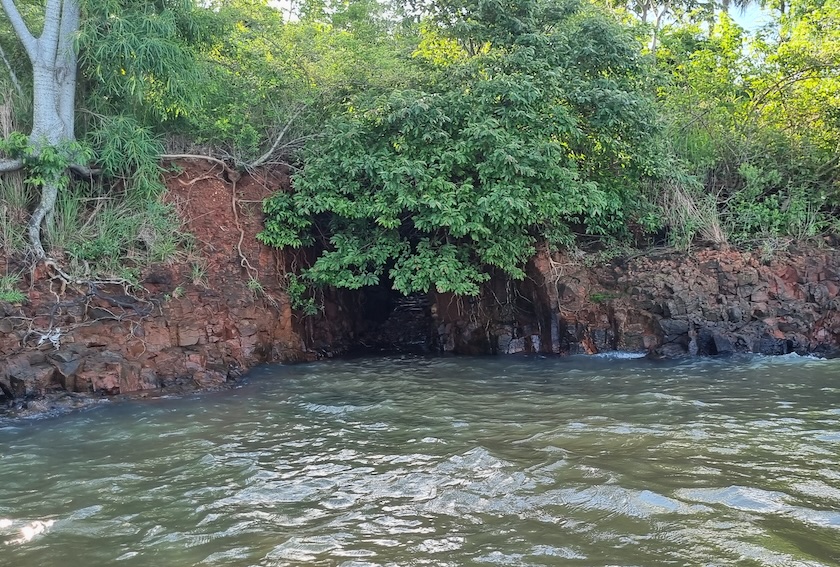
In one particularly enclosed stretch of forest, tangled with vines and towering trees, we encountered the entrance to an abandoned tunnel once used to connect the river with the mission. It can no longer be entered, yet its presence alone invites reflection—on movement, effort, and the invisible threads linking river and land.
Omar’s stories emerged naturally, without emphasis. At one moment he mentioned the surprising depth of the water beneath us; at another, he recalled a fire that once swept through the nearby nature reserve. His words carried no nostalgia, only continuity.
We continued dudownstream. The Paraná widened into silence, powerful and unhurried. The opposite shore dissolved into the horizon, sunlight trembling across the surface. When the wind rose, the water grew restless, sending small waves against the hull. Omar adjusted our course instinctively, anticipating the river’s movements long before they became visible.
Along the way, we passed hidden inlets and narrow streams swallowed by forest. High in the canopy, a family of howler monkeys rested motionless, observing us from above. Their presence felt like a quiet acknowledgment, a reminder that this is a shared territory—alive, complex, and fragile.
Our journey led us to one of the region’s most discreet yet powerful sites: the old Jesuit quarry. More than four centuries ago, Guaraní communities and missionaries extracted stone here to build the Mission of San Cosme y Damián. The reddish rock face, now softened by moss and humidity, still bears the marks of that labor. Standing before it, surrounded by jungle and silence, the past feels neither distant nor monumental, but human and tangible.
Moments like this resist explanation. They are felt rather than understood.
Traveling the Paraná with a local fisherman is not about reaching a point on a map. It is about learning to move at the river’s pace, listening to stories shaped by water and time, and recognizing that culture and nature here are inseparable.
In that slow navigation, guided by memory and experience, the Paraná offers something increasingly rare: a sense of connection that flows as quietly and deeply as the river itself.
-

© 2025 Copyrights - Todos los derechos reservados