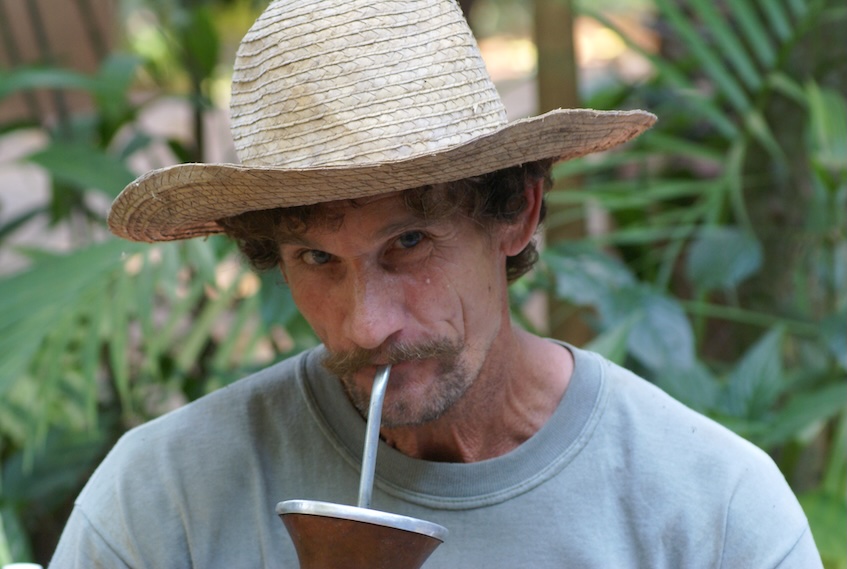
Drinking mate is a tradition that accompanies our mornings, travels, and daily gatherings. This simple infusion carries a deep meaning that transcends borders and generations. For us, mate is an unbreakable tradition we share every day—at dawn, during breakfast, or whenever we feel like it. Yet, while mate reigns supreme in Argentina and Uruguay, tereré is the favorite in Paraguay. Beyond its current consumption, yerba mate has a rich history that takes us back to the Guaraní people and the Jesuit missions, surrounded by legends that connect us to its origin.
Yerba mate is so closely tied to the identities of Argentina, Paraguay, and Uruguay that it has become a kind of national beverage. These three Spanish-speaking countries share a common history of Spanish colonialism and, later, tense struggles for independence—first from the Crown, and later among themselves and with the Portuguese-Brazilian empire to the north. Thus, while there may not be a single “correct” way to drink yerba mate, there is a typically Paraguayan way, a Uruguayan way, and an Argentine way. The same applies to language and accents: the Rioplatense Spanish spoken in Argentina, Paraguay, and Uruguay has features that distinguish it from other dialects, yet each country’s accent remains unmistakable. The same happens with recipes or ways of preparing mate.
Long before yerba mate became a symbol of South American identity, the Guaraní people already knew and consumed it. For them, yerba mate was not just a drink but a gift from nature and a sacred element. They gathered the leaves of the yerba mate tree, dried them, and ground them to prepare an infusion that accompanied them in their journeys and rituals. This tradition remained alive even after the arrival of Europeans, who adopted the consumption of mate and spread it throughout the Spanish colonies.
During the period of the Jesuit missions, yerba mate became one of the main sources of income for the Guaraní-Jesuit settlements. The Jesuits promoted its cultivation and obtained a monopoly over its trade, distributing it to nearby colonies and consolidating it as a valuable product. This period marked the beginning of yerba mate’s popularization, which today is widely consumed in Argentina, Uruguay, and Paraguay.
In Argentina, mate is a custom that begins in the morning and accompanies people throughout the day. It is drunk hot, in family gatherings, among friends, or even alone as a comforting pause.
In Paraguay, on the other hand, tereré takes the spotlight. This cold version of mate has a unique and sophisticated touch: cold water is mixed with aromatic and medicinal herbs that are crushed in a mortar. The herbal water, infused with flavor and health benefits, is then poured into the guampa, which holds the yerba. Tereré is not just a drink—it is a symbol of Paraguayan identity.
At San Cosme y Damián Lodge & Spa, both mate and tereré are essential companions. It’s not only about the beverage itself, but also about the process of preparing and sharing it with those who wish to experience it—rituals that make each stay truly authentic.
While we encourage tourists to try it, we never insist. Usually, after initially declining, curiosity wins and everyone ends up having a taste. In social gatherings, you’ll inevitably be offered a mate, and refusing the bitter drink (though some people sweeten it with sugar) is not an option—it may even be seen as a cultural slight. However, we are not fundamentalists of mate and never push anyone.
We find it amusing to observe that the first time someone unfamiliar with the region tries traditional mate or tereré, they almost always break one of the unspoken rules of the South American ritual—for example, grabbing the bombilla (metal straw) between their index finger and thumb while drinking. In reality, there is a reason (or myth) for not touching the bombilla: it is said that moving it too much while drinking can prevent the water from filtering properly through the leaves, causing it to “get clogged.”
Despite their differences, both mate and tereré share the same purpose: connecting people. Whether it’s in a circle of mates by the warmth of the home or enjoying tereré under the shade of a tree, these drinks create moments of pause, reflection, and companionship. They are an excuse to talk, to listen, and to enjoy the simplicity of sharing.
Yerba mate, in all its forms, is much more than a beverage. It is a tradition that has transcended centuries, uniting generations and cultures through a simple gesture: sharing. From the Guaraní who discovered it to those of us who enjoy it today, mate remains a symbol of connection, peace, and gratitude. Each sip reminds us that true magic lies in simplicity.
-

© 2025 Copyrights - Todos los derechos reservados