In the very heart of the Río de la Plata Basin – a land of deep red earth, embraced by two of the continent’s greatest rivers, the Paraná and the Uruguay – a most fascinating chapter in the history of the Americas unfolded: the Jesuit-Guaraní Missions. This was a region of boundless natural wealth, where untamed forests, extraordinary flora and fauna, and an ever-present pulse of life shaped the land. It was here that two worlds – the Western and the Guaraní – met and gave birth to an unprecedented model of coexistence. A social, cultural, and spiritual experiment that, despite its tragic end, left an indelible mark on the identity of this land.
My first encounter with this legacy did not take place during a journey, but within the pages of books. I had studied the history of the missions at university, yet never imagined that, years later, I would walk these lands guided by their true heirs: the Guaraní communities who, even today, keep this heritage alive. It was in 2005 when a friend first introduced us to the realities of these villages, inspiring us to witness their living conditions first-hand. What began as a humanitarian initiative to help the Chapa community – a small Guaraní village without access to clean water – became a personal discovery that would forever change how I understood history, and my own place in the world.
The story of the missions is both unique and compelling. During those years of conquest and colonisation in South America, there prevailed a firm conviction that Christian Europe represented the only model worth emulating. The Spanish conquest and colonisation were thus legitimised by the conquerors’ pledge to Christianise the native populations – an ideology that coexisted with an insatiable thirst for wealth.
At the same time, Portuguese colonisation in Brazil was taking place alongside the Spanish expansion throughout the rest of the continent. The Portuguese practised a destructive mode of occupation: as they advanced inland, they enslaved native peoples through the Bandeiras – ruthless expeditions of conquest. By the early seventeenth century, the Bandeirantes had reached what is now Mato Grosso, bordering the Spanish-controlled lands known as the Territory of Jerez, where the first indigenous settlements belonging to the Jesuit Province of Paraguay were beginning to appear.
The members of the Society of Jesus – a religious order younger than the “New World” they had entered – arrived with different ideals. They came to the lands of the Guaraní to uphold a papal bull that expressly forbade the enslavement of indigenous peoples and sought to defend their liberty and their right to property.
The Jesuit Province of Paraguay was founded in 1604, marking the beginning of the missionary work among the Guaraní. A full century had already passed since that “meeting of worlds”, with all its conquest and colonisation.
The history of the native peoples, however, stretches far back before the arrival of Europeans. For centuries they had lived amidst the dense forests and wetlands of the Paraná basin. Their society was organised and spiritually attuned to nature, guided by a vision that sought the “land without evil” – a mythical place where they could achieve their highest purpose. Their way of life changed dramatically with the arrival of the Spanish and Portuguese. The constant slave-hunting raids by the Portuguese were a scourge upon them, and combined with the greed of the Spanish settlers who exploited them, they were forced to choose between retreating deeper into the forest or seeking protection in the Jesuit missions. Those who chose the latter forged a new way of life.
The Jesuits organised the natives into reducciones (missions). While they adopted some elements of local social life, they transformed the Guaraní’s semi-nomadic existence into an ordered urban environment – a structure that enabled them to achieve their dual aims of evangelisation and protection.
In total, forty-eight missions were established, of which thirty endured. Each was a fully fledged community built around its church. These settlements became pioneers in ironworking, textile production, yerba mate cultivation, and cattle breeding – skills and industries that would later spread across the southern pampas.
This experiment in social organisation, founded on cooperation and mutual respect, drew to the region architects, musicians, and artisans, who arrived to study, teach, and be inspired.
Travelling through this region – winding through northeastern Argentina and Paraguay – immerses one in a landscape of red earth, lush greenery, and echoes of a glorious past. Here, deep in the forest, rose the reducciones that once housed over a hundred thousand Guaraní, thriving in self-sufficient communities where education, music, and art flourished like nowhere else in the New World. These thirty towns evoked both admiration and suspicion among the political powers of their time.
The missions were far more than religious settlements; they were cities – meticulously planned and socially advanced. The Society of Jesus, guided by its progressive vision, introduced a system in which the Guaraní were not merely converted, but educated and trained in diverse crafts and arts. Their imposing buildings, of remarkable architecture, included churches, workshops, schools, and dwellings – all designed around a grand central square, the beating heart of each community.
Though the story of the missions may be told through chronicles and records, nothing compares to hearing it from the descendants of those Guaraní who once inhabited the reducciones.
My first visit to the Chapa community was a turning point. Despite having a small school, the children spoke only Guaraní. They lacked access to clean drinking water, relying on a small spring whose quality had never been tested. The scarcity of resources was striking.
In that moment, I realised that the true legacy of the missions does not lie solely in their ruins, but in the daily struggle of these communities to preserve their culture in a world that so often overlooks them. Since then, every journey to the region has been a lesson – a rediscovery of that Jesuit-Guaraní utopia that, far from vanishing, lives on in the identity of its people.
The missions were seen by some as a masterpiece of humanity and by others as a threat to the Crown’s authority. Voltaire, despite his fierce criticism of religion, described them as “a triumph of humanity”. Yet their success inevitably drew the attention of those who viewed the Society of Jesus as a danger. “The missions” became a topic of intrigue in the royal courts of Europe. This “triumph of humanity” unsettled those who feared the growing power of the Jesuits. Some claimed that the Order was building a republic in the Río de la Plata region, amassing wealth and influence beyond the reach of Spanish and Portuguese control. Others accused them of cynicism and conspiracy.
That model met its end in blood and fire. Suspicion, fuelled by political intrigue and rivalry, led to the expulsion of the Jesuits in 1767 and the subsequent looting and destruction of the reducciones. Bereft of protection, the Guaraní were captured or forced to flee into the jungle – many taking refuge in the wetlands of Iberá or dispersing across the land.
Their ruins, their language – rich in sound and rhythm – their traditions, and their worldview have survived the passage of centuries, and today they form part of the cultural fabric of Paraguay and northeastern Argentina, which we invite you to discover through our travels.
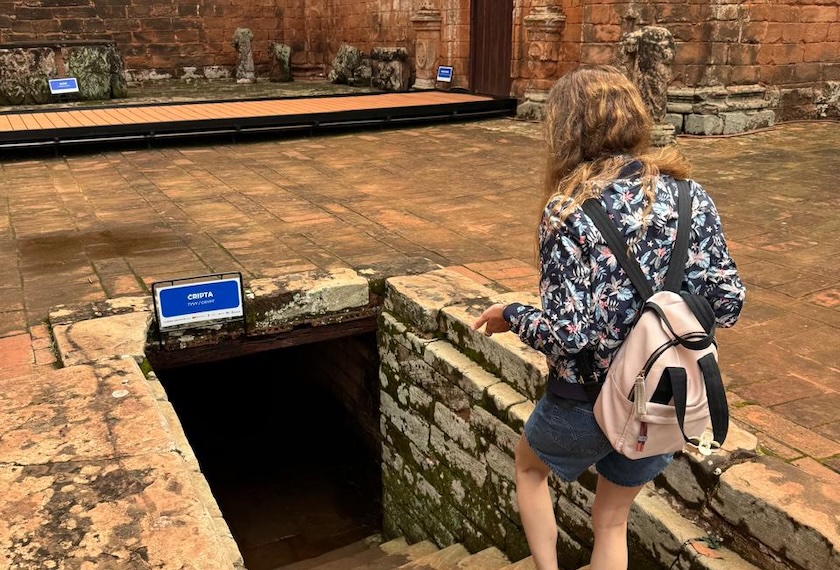
To wander through the missions is not merely to travel through time, but to meet nature itself. The red dirt roads, the palm-dotted fields, and the small wooden houses accompany travellers through a route where each stop offers a window into the past. The ruins of San Ignacio Miní, San Cosme y Damián, Trinidad, and Jesús de Tavarangüé, among others, allow us to imagine the splendour of those reducciones that once resonated with the music of violins and organs crafted by the Guaraní themselves.
Personally, I am enchanted by the Jesuit missions. I never miss the chance to explore the ruins of their churches, schools, and homes, and I take great joy in learning about the Jesuit influence in the region and the lives of the indigenous communities who once inhabited these lands. For me, this journey is far more than a touristic adventure – it is an opportunity to share with fellow travellers what I have learnt over the years: that the Jesuit missions are not merely ancient stones, but the enduring testimo...
The Jesuit missions stand as a symbol of what could have been, yet never was – a model of integration that defied the structures of its time, and that, though destroyed, continues to inspire all who tread its paths. A journey through these lands not only allows us to admire their legacy, but also to reflect upon lost opportunities and upon the stories that, though buried beneath centuries of silence, still have much to tell.
Cristian van Gent - 2024

© 2025 Copyrights - Todos los derechos reservados